
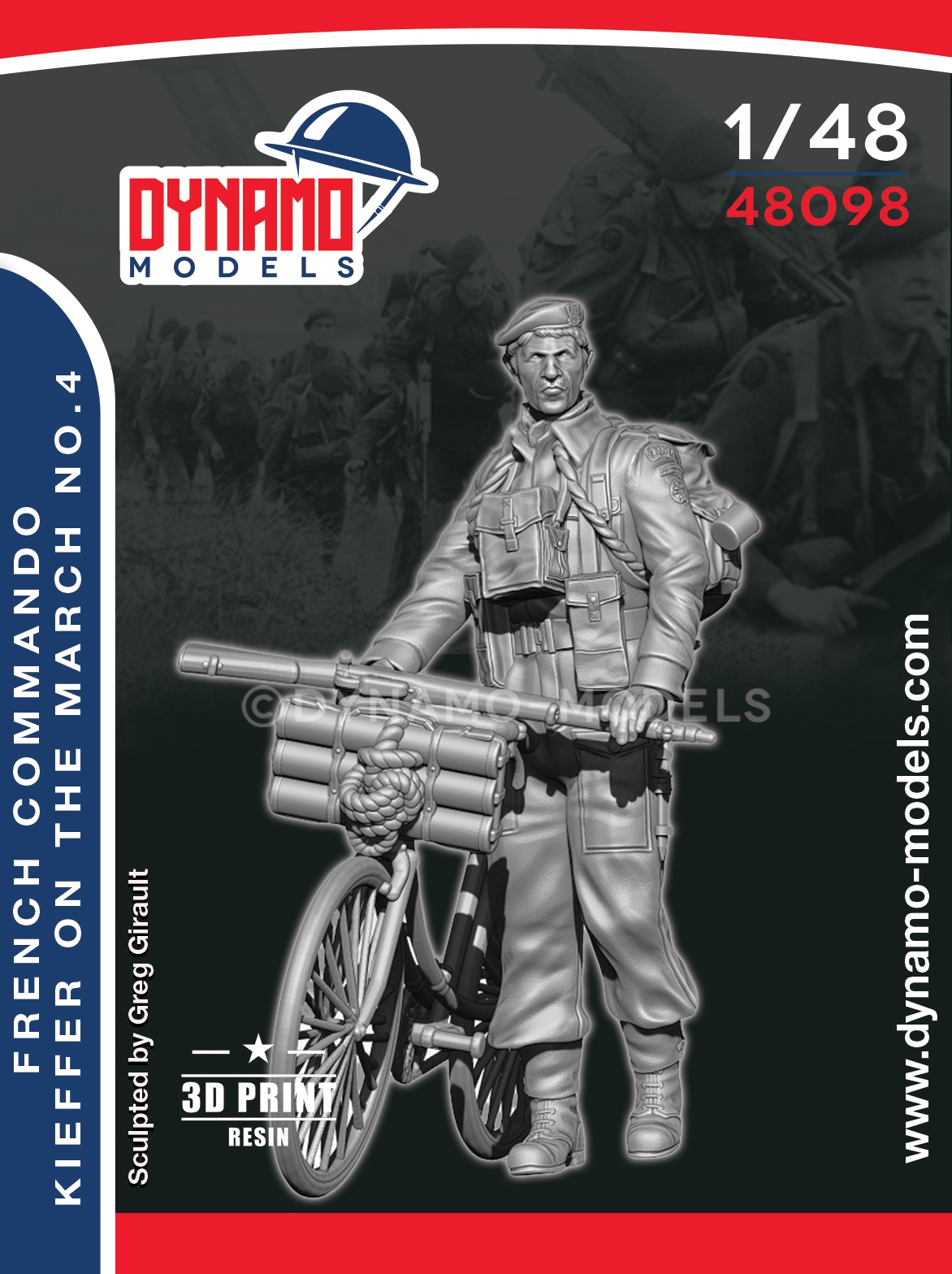

1/48 French Commando Kieffer Marching (with Bicycle) No.4
8,20€
The 1/48 French Commando Kieffer Marching (with Bicycle) No.4 depicts a Free French naval commando advancing inland after Sword Beach, guiding a civilian bicycle used for reconnaissance and mobility. With accurate uniform sculpting and a finely detailed bike, it adds originality, realism, and narrative depth to Normandy dioramas.
What’s Included:
- 1 resin French Commando Kieffer figure in marching pose (1/48 scale)
- 1 resin bicycle
- Assembly required
- Unpainted pieces
- Glue and paint not included
Historical Context & Theme
The French Commando Kieffer Marching (with Bicycle) No.4 figure represents a highly distinctive and historically grounded moment within the D-Day operations carried out by the 1er Bataillon de Fusiliers Marins Commandos. While most imagine these elite naval commandos storming Sword Beach under fire, their mission did not end at the shoreline. After penetrating German defenses at Ouistreham, Kieffer’s men advanced inland to secure key objectives, often improvising mobility and equipment along the way.
During the early hours of June 6, 1944, the battalion operated in tandem with British No.4 Commando and supporting armored units. Once the immediate beachfront was secured, one of their critical tasks was pushing quickly into Ouistreham to eliminate German defensive positions, seize the lock and canal structures, and establish links with airborne troops further east. In the urban and semi-rural terrain around the town, bicycles—often confiscated from civilians or German stores—became valuable tools for reconnaissance, liaison, and local transport.
This figure captures the essence of this improvisation. A French commando marching forward while guiding a bicycle reflects both the resourcefulness and adaptability of Kieffer’s men. Bicycles offered silent movement, allowed patrols to cover ground more quickly, and served as practical means of carrying gear, ammunition, or even wounded comrades. This rare combination makes the figure unique in WWII miniature modeling, offering a fresh angle on Free French involvement in Normandy.
Historically, such scenes were common in liberated towns where Allied troops made use of available civilian resources. The figure symbolizes the transitional moment between amphibious assault and inland consolidation—a phase often overlooked in traditional D-Day dioramas. As commandos moved further into Ouistreham, bicycles could be seen leaning against walls, carried across rubble, or used for quick reconnaissance up narrow streets.
Thematically, the figure represents strategic adaptability, the blending of military and civilian environments, and the progression from combat beachhead to urban operations. It invites modelers to explore nuanced narratives beyond the initial landing waves and brings historical depth to the Free French story.
Figure Details & Realism
The French Commando Kieffer Marching (with Bicycle) No.4 sculpt includes both a detailed commando figure and a finely modeled bicycle scaled precisely to 1/48 proportions.
Key sculpt features include:
– Authentic British battledress worn by Kieffer commandos
– Correct commando helmet shape and gear arrangement
– Natural marching posture with one hand steadying the bicycle
– Subtle shifts in fabric tension indicating movement and weight
– Webbing gear, pouches, and dagger placement with accurate detailing
– Bicycle frame, wheels, handlebars, and chain area sculpted with crisp lines
– Tire tread and metal tubing realistically proportioned despite small scale
The interaction between man and bicycle is central to the figure’s realism. The hand position, body angle, and leg stride are sculpted to show genuine forward motion, avoiding stiffness or unnatural alignment.
Painters will enjoy weathering the bicycle—rust, dust, chipped paint, and worn rubber—to match Normandy’s rural or urban conditions.
Diorama & Display Use
This set dramatically expands diorama possibilities by introducing a prop that changes movement, composition, and narrative tone.
Suggested settings include:
– Ouistreham streets, where bicycles were commonly found after liberation
– Normandy village lanes, with the commando advancing past stone walls or fences
– Post-assault reorganization scenes, showing units regrouping inland
– Reconnaissance patrols, using bicycles for silent movement
– Interactions with civilians, reflecting the mixed environment after D-Day
– Rural pathways, transitioning from the coast toward strategic objectives
– Bicycle-lined courtyards, typical of French town centers
The figure pairs seamlessly with other marching commandos (No.1–3), creating a multi-character patrol advancing toward new objectives. The bicycle adds vertical structure and visual interest, enhancing scene composition.
Material & Customization
Cast in premium resin, both the figure and the bicycle maintain clear detail and require minimal cleanup.
Customization options include:
– British battledress shading and highlighting
– Helmet weathering with or without netting pattern
– Bicycle color options (civilian black, military green, or improvised tones)
– Dust, mud, or rust effects depending on terrain
– Personalized dagger painting and leather gear detailing
– Seawater staining for early post-landing scenes
Assembly and painting required. Glue and paint not included.
Who It’s For
Ideal for:
– D-Day diorama builders
– Collectors of Free French Forces miniatures
– Modelers seeking unusual WWII subject matter
– Painters who appreciate dynamic movement and object interaction
– Diorama creators building Normandy urban or rural scenes
– Anyone wanting to diversify commando poses with unique equipment
The bicycle transforms this figure into a storytelling focal point.
| Poids | 0,022 kg |
|---|---|
| Brand | Dynamo Models |
| Country | France, Great Britain |
| Material | 3D print |
| Period | WW2 |
| Scale | 1/48 |